PSR Weekend Knot — Landing Article | Five Articles. One Knot.
Start here:
If you only have 5 minutes:
Read Hormuz Binds Washington — it explains how a sea lane becomes U.S. domestic pressure.
If you follow Ukraine/Russia:
Read Kyiv Presses. Moscow Pays. — it explains why Ukraine targets Russia’s war throughput.
If you follow China / Indo-Pacific / military strategy:
Read Carriers Bind. Regions React. — it explains deterrence density.
If you follow Europe / NATO / Germany / UK:
Read Europe Must Carry. But Fast Enough? — it explains why Europe is heavy, not weak.
If you want the full system:
Read the Long Read Main Report.
Scroll down to the individual parts with the link.
Subtitle:
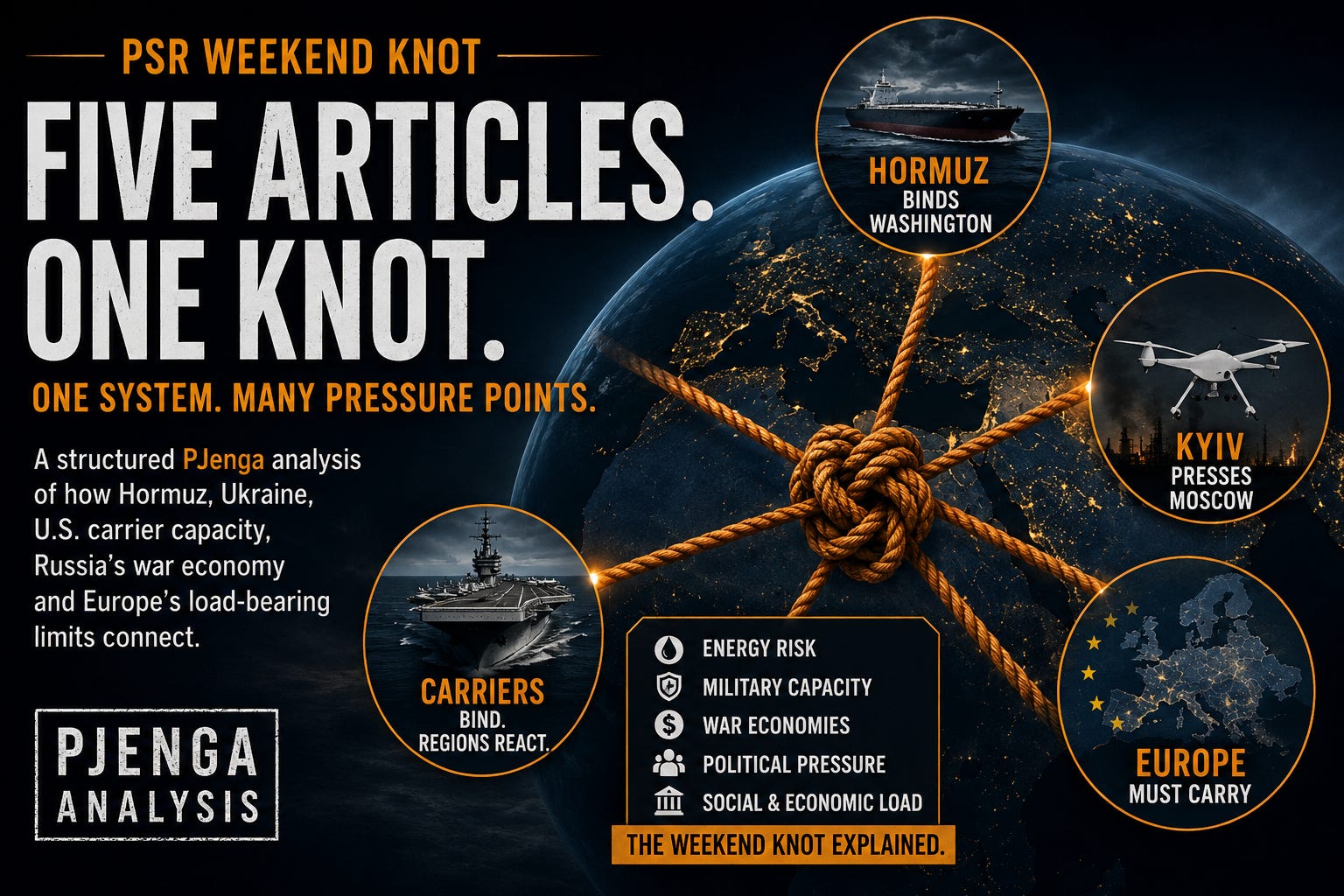
A structured PJenga analysis of how Hormuz, Ukraine, U.S. carrier capacity, Russia’s war economy and Europe’s load-bearing limits connect.
⸻
Out of one dense crisis weekend, a five-part PSR Weekend Knot emerged.
Not as a conventional news chronology.
Not as a list of separate crises.
Not as another round of geopolitical noise.
But as a PJenga analysis:
Which systems suddenly carry more load?
Where is strength being tied down?
Where does pressure migrate next?
Which buffers still look stable, but are already leaking?
The core idea is simple:
These are not separate crises. They are connected load paths.
Hormuz does not remain in the Strait of Hormuz.
It moves into oil prices, insurance markets, shipping decisions, U.S. domestic politics and Trump’s room for maneuver.
Ukraine’s deep strikes do not remain military incidents.
They move into Russia’s export logistics, war financing, air defense allocation, repair costs and the Kremlin’s narrative of control.
A U.S. carrier is not merely a ship.
It is mobile deterrence density. When it is tied to one theater, other regions react.
And Europe is not simply weak.
Europe is heavy: economically, socially, institutionally and politically. But in this crisis era, heavy systems must learn to move faster.
That is the purpose of this five-part series.
It is designed for readers who do not want to consume geopolitics as isolated headlines. It is for people who want to understand how the Middle East, oil prices, Ukraine, Russia, China, NATO, U.S. military capacity and Europe’s internal limits belong to the same structural field.
The main report provides the matrix.
The four excerpts isolate the major load paths.
⸻
1. Main Report
PSR Weekend Knot — Hormuz Binds. Kyiv Presses.
The main article maps the full weekend structure: Hormuz binds Washington, Kyiv pressures Moscow, U.S. carrier capacity shifts deterrence density, and Europe becomes the heavy load-bearing system that must absorb more responsibility.
It is the full PJenga matrix of the weekend.
Read the main report:
PSR Weekend Knot — Hormuz Binds. Kyiv Presses.
⸻
2. Excerpt 1
Hormuz Binds Washington
How does a sea lane become a domestic pressure point for the United States?
This article explains why the Strait of Hormuz is not only a maritime chokepoint, but a political amplifier. It connects shipping risk, oil prices, insurance premiums, fuel prices and Trump’s domestic room for maneuver.
The wrong sentence would be:
“Trump has to keep Hormuz open.”
The better sentence is:
“Trump has to stabilize Hormuz in a way that markets, insurers, shipping companies and American voters believe energy flows are predictable again.”
Read Excerpt 1:
PSR Weekend Knot — Excerpt 1/4 | Hormuz Binds Washington
⸻
3. Excerpt 2
Kyiv Presses. Moscow Pays.
Ukraine is not only attacking Russian infrastructure.
It is attacking Russia’s war throughput.
Oil exports.
War revenue.
Repair capacity.
Air defense allocation.
The illusion of a safe hinterland.
The central argument:
Kyiv is moving the war from the front line into Russia’s war-financing machine.
This article looks at why Ukraine pressures Russia’s energy and export logistics exactly when the U.S. is tied down by Hormuz and the Middle East.
Read Excerpt 2:
PSR Weekend Knot — Excerpt 2/4 | Kyiv Presses. Moscow Pays.
⸻
4. Excerpt 3
Carriers Bind. Regions React.
A carrier is not just a ship.
It is floating air power.
It is command structure.
It is political signal.
It is deterrence.
It is tied strategic capacity.
When the United States shifts naval mass into the Middle East, the effect is not limited to Iran. Moscow watches. Beijing watches. Europe watches. NATO watches. Markets watch.
The key concept is deterrence density:
Not how much military power exists in total, but how much is available, credible, coordinated and politically usable at the right place and time.
Read Excerpt 3:
PSR Weekend Knot — Excerpt 3/4 | Carriers Bind. Regions React.
⸻
5. Excerpt 4
Europe Must Carry. But Fast Enough?
The final excerpt shifts the focus to Europe.
Europe is not weak.
Europe is heavy.
It has enormous economic, social, industrial and institutional mass. But that mass is slow. Its diversity, consensus mechanisms and legal safeguards protect the system in normal times — yet they can become friction in an era where load moves faster than procedures react.
The wrong sentence would be:
“Europe is too weak.”
The better sentence is:
“Europe is strong, but its strength is in the wrong state of matter: too much mass, not enough speed.”
Read Excerpt 4:
PSR Weekend Knot — Excerpt 4/4 | Europe Must Carry. But Fast Enough?
⸻
The Core Pattern
Hormuz binds Washington.
Kyiv presses Moscow.
Carriers bind regions.
Europe must carry.
The wrong sentence would be:
“These are several separate crises.”
The better sentence is:
“This is one connected load system.”
PJenga does not only ask:
What happened?
PJenga asks:
What now carries more load?
That is the point of this series.
It is not meant to replace news.
It is meant to help read news structurally.
Please share and become a follower or even a subscriber if you like these PJenga analysis Articles…